Advanced
A deep dive into Falcn’s architecture, from high-level system design to individual component interactions.
System Overview
Falcn is built as a modular, pipeline-based security scanner designed for high throughput and extensibility. The architecture separates concerns between input parsing, detection algorithms, AI analysis, and output generation.
High-Level Architecture

Figure 1: Falcn processes packages through multiple detection layers before generating outputs
Core Components
📥 Input Layer
Accepts requests from CLI, REST API, or CI/CD webhooks. Normalizes input into a standard PackageRequest format regardless of source.
⚙️ Core Engine
Orchestrates the scanning pipeline. Manages concurrency, caching, and coordination between detection algorithms.
🔍 Detection Layer
Runs multiple detection algorithms in parallel. Each algorithm produces independent threat scores that are aggregated.
🤖 AI Layer
Optional component that generates human-readable explanations using locally-running LLMs via Ollama.
Scan Pipeline Flow
When a scan is initiated, packages flow through a multi-stage pipeline:
Scan Pipeline Sequence
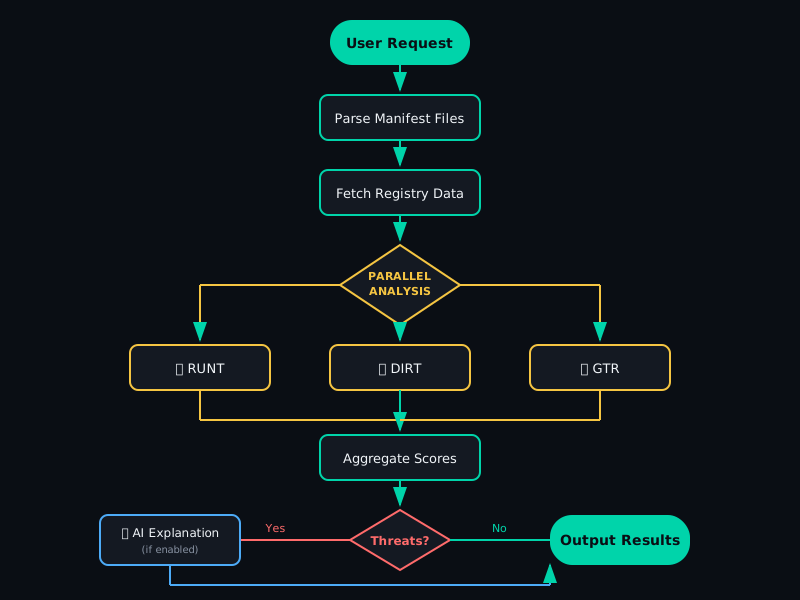
Figure 2: Sequence diagram showing the scan pipeline from user request to output
Detection Algorithm Architecture
RUNT (Registry Uncover Naming Threats)
RUNT specializes in detecting typosquatting attacks by comparing package names against known legitimate packages using multiple string similarity algorithms.
RUNT Detection Flow
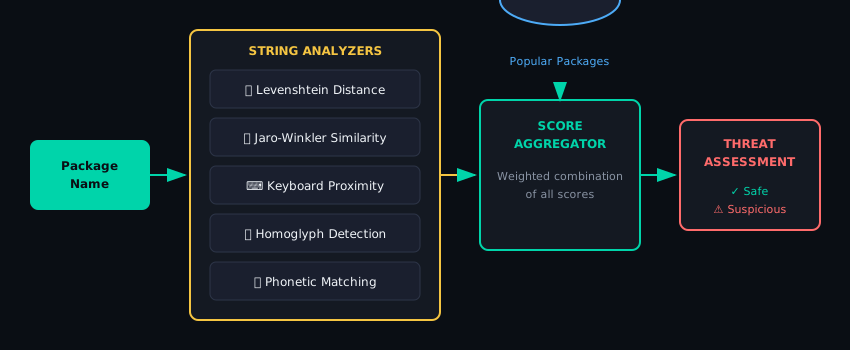
Figure 3: RUNT uses multiple string analyzers to detect typosquatting
Attack Types Detected
| Attack Type | Example | Target |
|---|---|---|
| CHARACTER_OMISSION | cros-env | cross-env |
| CHARACTER_SWAP | axois | axios |
| CHARACTER_INSERTION | expresss | express |
| HOMOGLYPH | cross-еnv (Cyrillic е) | cross-env |
| KEYBOARD_TYPO | lodasj | lodash |
DIRT (Dependency Intelligence Risk Tracker)
DIRT assesses business and security risk based on package metadata, maintainer activity, and historical patterns.
📊 Risk Signals
- Package age & download trends
- Maintainer activity
- Dependency count
- Known CVEs
- License type
⚖️ Risk Levels
- LOW – Minimal concern
- MEDIUM – Review recommended
- HIGH – Significant risk
- CRITICAL – Immediate action
GTR (Graph Threat Recognition)
GTR analyzes the dependency graph to identify suspicious patterns:
- Circular Dependencies – Packages that depend on each other
- Excessive Depth – Unusually deep dependency chains
- Shadow Dependencies – Hidden transitive dependencies
- Namespace Confusion – Internal vs external package conflicts
AI Integration Architecture
Falcn’s AI layer provides human-readable explanations for detected threats without sending code to external services.
🔒 Privacy Guarantee
Only package metadata (name, version, similarity scores) is sent to the local LLM. Your source code, environment variables, and file contents never leave your machine.
Local AI Flow
- Threat detected by detection algorithms
- Falcn builds a prompt with package metadata only
- Prompt sent to local Ollama server (localhost:11434)
- LLM (Llama 3, Mistral, etc.) generates explanation
- Explanation parsed and included in results
Deployment Architectures
Developer Workstation
Simplest setup – CLI and optional Ollama running locally:
# Install and run
curl -sSL https://falcn.io/install | sh
falcn scan .
CI/CD Pipeline
Integrate with GitHub Actions, GitLab CI, or Jenkins:
- name: Security Scan
  uses: falcn-io/falcn-action@v2
  with:
    mode: fast
    fail-on-violation: true
Enterprise Deployment
For large organizations, deploy Falcn as a service:
- Load Balancer – Distribute scan requests
- API Cluster – Multiple Falcn API servers
- Redis Cache – Shared result caching
- AI Cluster – Dedicated Ollama nodes
- Observability – Splunk, Prometheus, Slack integration
Component Reference
| Component | Technology | Purpose |
|---|---|---|
Scanner Engine | Go | Core orchestration and parallel processing |
Package Parser | Go | Multi-format manifest parsing |
Registry Client | Go + HTTP/2 | Efficient registry communication |
RUNT Algorithm | Go | String similarity analysis |
DIRT Algorithm | Go | Risk scoring engine |
GTR Algorithm | Go | Graph analysis |
Sandbox | Docker + seccomp | Behavioral analysis |
LLM Connector | Go + gRPC | Ollama integration |
REST API | Go + Chi router | HTTP interface |
Cache Layer | Redis / In-memory | Result caching |
📚 Want to Contribute?
Falcn is open source! Check out our Contributing Guide to learn about the codebase structure and how to add new detection algorithms.